By Archie the Foot | 6 min read
When Your Foot Keeps Saying, “We’ve Tried That Already”
Hi, Archie the Foot here.
If you have been dealing with chronic heel pain, tendon pain, forefoot discomfort, or another stubborn foot problem, you may already know the routine.
Rest.
New shoes.
Stretch.
Ice.
Injection.
Another pair of shoes.
More rest.
Then somebody eventually says:
“Have you considered regenerative medicine?”
And suddenly the conversation becomes a bowl of alphabet soup:
PRP. BMAC. ECM. HCT/P. DPM-X.
That is usually when Archie puts on the glasses.
Today, let’s talk about DPM-X, what it actually is, what it is not, and where a structural tissue allograft might fit into a thoughtful foot and ankle treatment strategy.
Because advanced medicine is useful only when we understand what we are actually doing.
First Things First: What Is DPM-X?
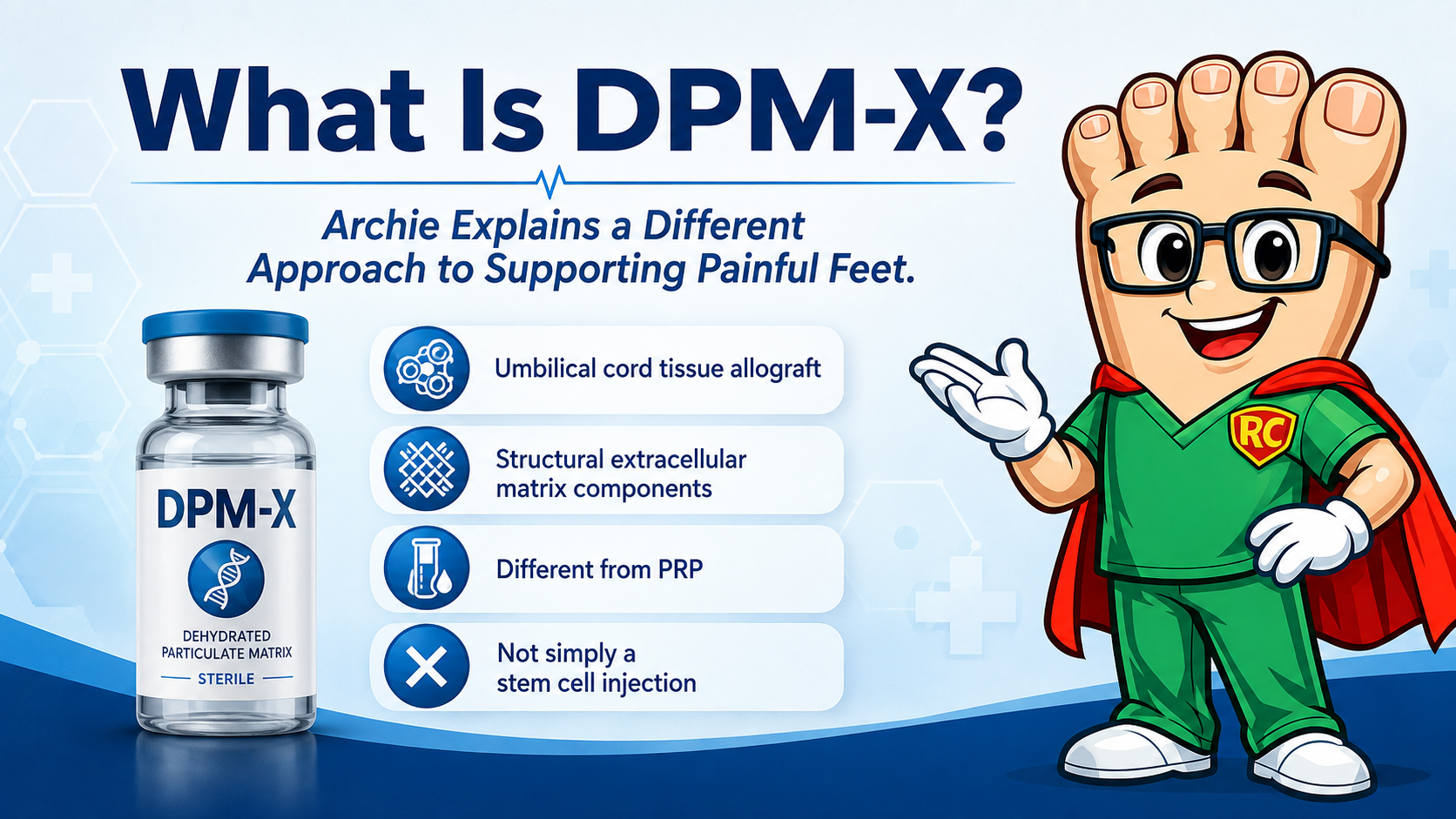
DPM-X is described by its manufacturer as a human birth tissue allograft derived from umbilical cord tissue and designed for podiatric use. The manufacturer says the tissue contains naturally occurring structural extracellular matrix components including elastin, hyaluronan, glycosaminoglycans, connective tissue, and other tissue components.
That’s a mouthful.
So Archie will translate.
Think of the extracellular matrix as part of the body’s structural scaffolding.
It helps provide physical characteristics such as support, flexibility, cushioning, and organization within tissues.
DPM-X’s manufacturer specifically positions the product around those structural and cushioning properties.
What DPM-X is NOT
This part is important.
DPM-X should not simply be called a stem cell injection.
The manufacturer’s current public description focuses on umbilical cord structural tissue and extracellular matrix components, not on delivering stem cells as the therapeutic mechanism.
That distinction matters because the term “stem cell therapy” is frequently used loosely in regenerative medicine marketing.
Archie’s rule:
If we don’t know exactly what’s in the vial and what it is intended to do, we shouldn’t invent a cooler name for it.
Why Does Structure Matter in the Foot?
Take a look down.
Your feet spend their day being smashed between two fairly unforgiving objects:
You and the Earth.
Every step creates load.
Walking, running, tennis, pickleball, golf, work, and simply standing all place mechanical forces through the skin, fat pad, fascia, tendons, ligaments, joints, and other structures of the foot.
Healthy tissues are designed to tolerate those forces.
But tissue can become irritated, degenerated, mechanically overloaded, injured, or less resilient over time.
The DPM-X manufacturer emphasizes the structural and cushioning characteristics of its umbilical cord allograft, including properties intended to supplement areas where connective tissue may be compromised.
That is a very different concept from simply “inject something where it hurts.”
And that brings us to one of Archie’s favorite topics.
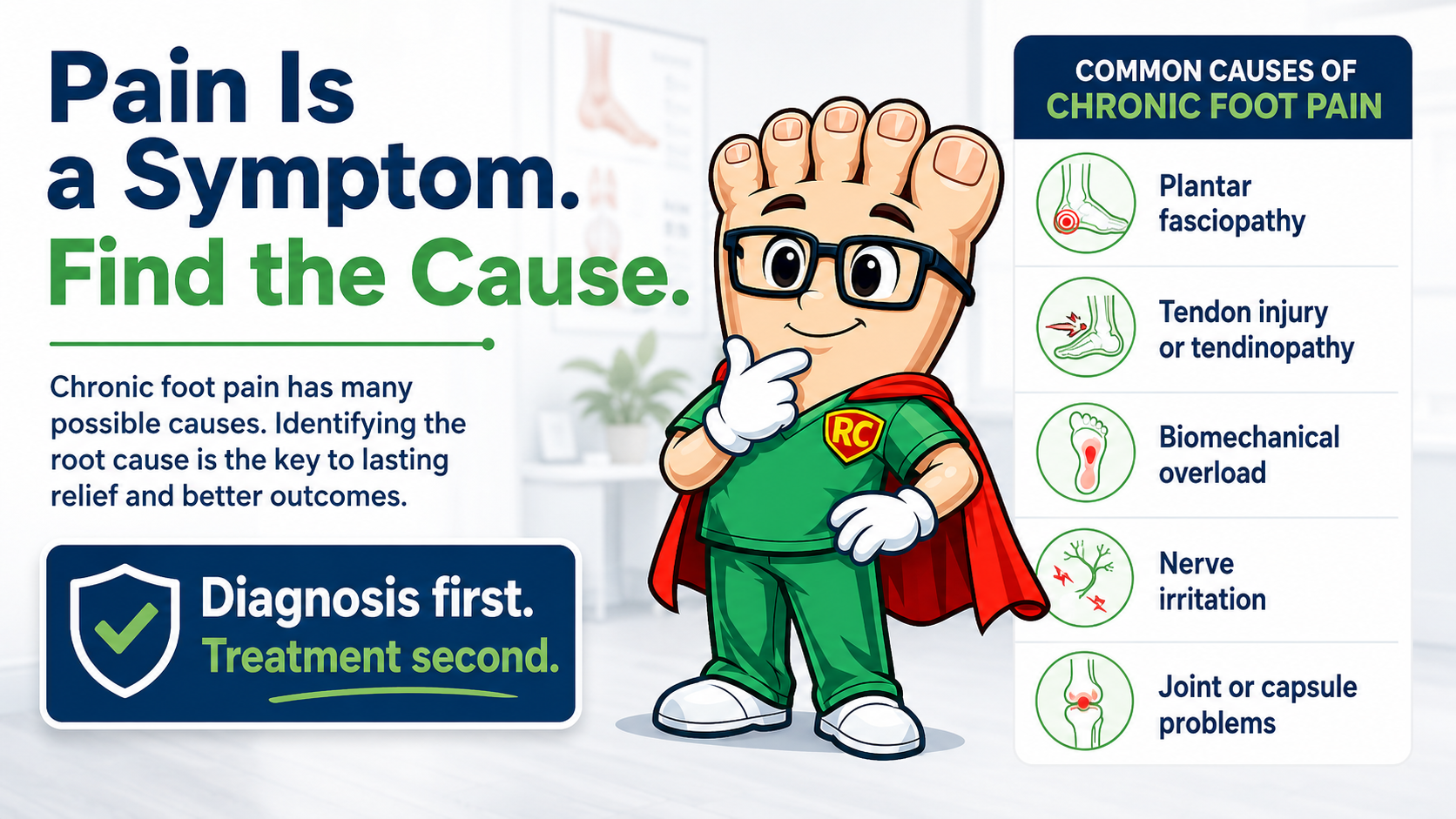
Pain Is a Symptom. We Still Need a Diagnosis.
Someone walks into the office and says:
“My heel hurts.”
Wonderful.
We have identified the zip code.
We have not identified the problem.
Heel pain might arise from plantar fasciopathy, nerve irritation, fat-pad problems, stress injury, tendon pathology, biomechanics, or another condition.
Likewise, pain near a tendon does not automatically tell us whether we are dealing with acute inflammation, chronic tendinopathy, a partial tear, mechanical overload, or something else.
The treatment should follow the diagnosis.
Not the other way around.
Where Does DPM-X Fit Compared With Other Treatments?
This is where regenerative medicine becomes confusing because several completely different treatments often get thrown into the same bucket.
They aren’t the same.
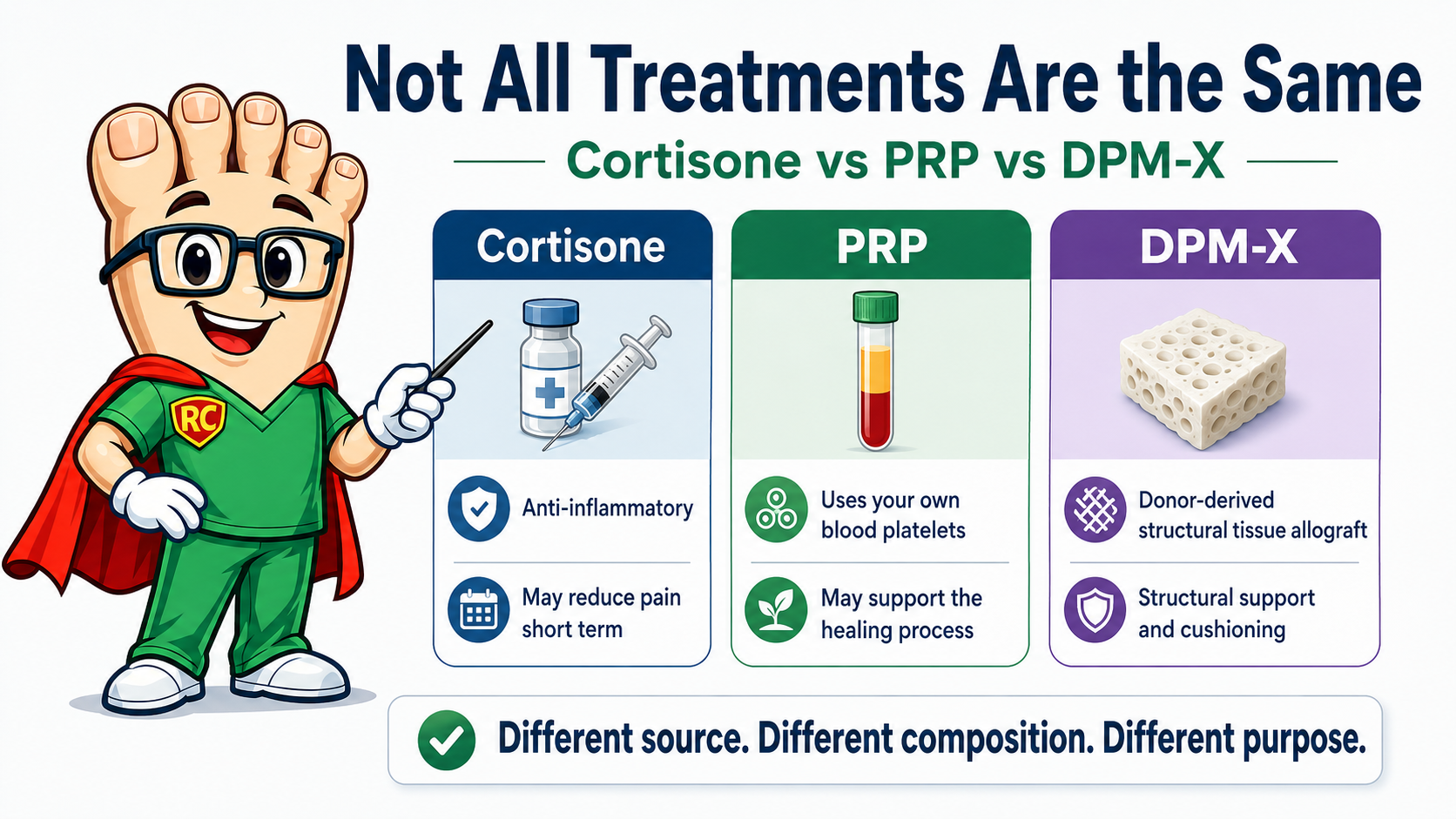
Cortisone
Corticosteroid injections are primarily used for their anti-inflammatory effects.
They can be useful in selected circumstances, but reducing inflammation and supplementing structural tissue are fundamentally different therapeutic concepts.
PRP
Platelet-rich plasma, or PRP, is made from your own blood.
Your blood is drawn, processed, and concentrated to produce a platelet-rich preparation that may then be used in selected musculoskeletal applications.
PRP is therefore an autologous treatment, meaning the material comes from you.
DPM-X
DPM-X is different.
It is an allograft, meaning the tissue comes from a screened human donor rather than from the patient’s own blood.
Its manufacturer characterizes it as an umbilical cord structural tissue product designed around properties such as cushioning, elasticity, compressibility, and structural support.
So:
PRP = your own blood-derived platelet preparation.
DPM-X = donor-derived structural tissue allograft.
Not interchangeable.
Not the same mechanism.
And definitely not two different brands of “stem cells.”
But Does Birth Tissue Automatically Heal Injured Feet?
No.
And this is an area where Archie has to take the superhero cape off for a minute.
There is scientific literature investigating various human birth-tissue products in musculoskeletal medicine. For example, randomized clinical trials have studied certain dehydrated human amnion and chorion membrane products for chronic plantar fasciitis. Some trials have reported improvements in pain and function compared with controls.
There is also emerging research involving Wharton’s jelly and other birth-tissue products.
But here is the critical distinction:
Evidence for one birth-tissue product cannot automatically be applied to DPM-X.
Different products can use different tissues, processing methods, preservation methods, concentrations, physical forms, and intended uses.
Therefore, studies of amnion, chorion, Wharton’s jelly, or another umbilical-cord-derived product should not be presented as proof that DPM-X produces the same result.
That would be scientifically sloppy.
Archie doesn’t do sloppy.
What About the FDA?
This deserves its own section because “FDA registered” and “FDA approved” sound similar to patients.
They are not the same thing.
DPM-X states that it is processed in an FDA-registered, AATB-accredited facility and describes its processing and donor-screening standards.
However, registration of a facility does not by itself mean that a specific product has received FDA approval.
FDA regulates human cells, tissues, and cellular and tissue-based products under a complex framework. Certain tissue products may be regulated under Section 361 of the Public Health Service Act if they meet specific requirements, including criteria involving minimal manipulation and homologous use.
FDA has also repeatedly warned that many products marketed broadly as regenerative or umbilical-cord treatments for orthopedic conditions may require additional regulatory approval.
DPM-X itself states:
Its product claims have not been evaluated by FDA, and the product is not intended to diagnose, treat, cure, or prevent disease.
That is the language I would want patients to understand before making a decision.
Advanced treatment does not require exaggerated marketing.
It requires informed patients.
How We Approach Advanced Foot and Ankle Care at River City
At River City Foot and Regenerative Medicine, our approach is not:
Pain → injection.
It is:
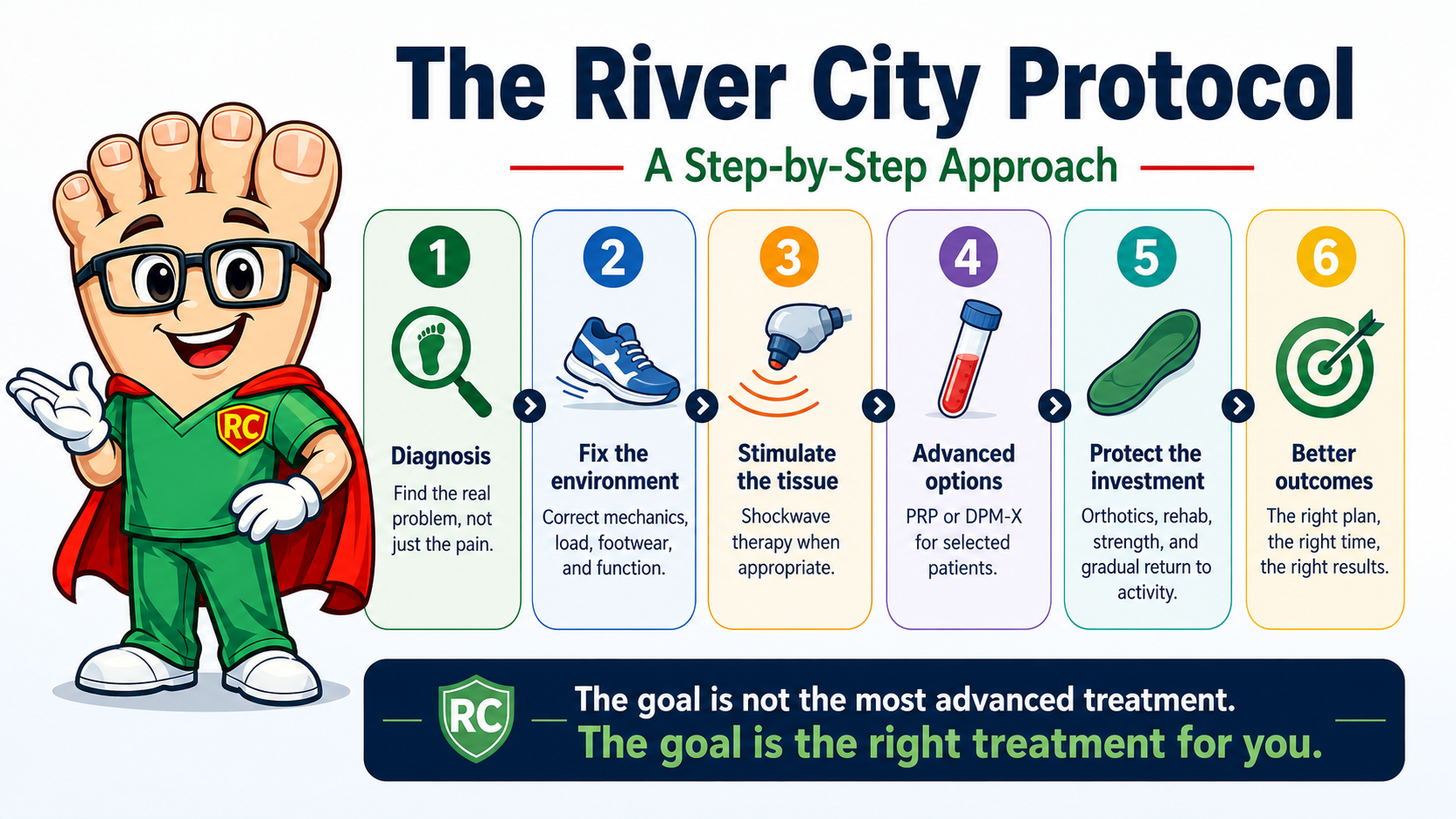
Diagnose → identify the mechanical problem → choose the least invasive treatment likely to work → reassess → escalate when appropriate.
Here’s what that may look like.
Step 1: Figure Out Why It Hurts
We start with the history and physical examination.
When appropriate, imaging or diagnostic ultrasound may help us better evaluate the tissue involved.
The question isn’t merely:
“Where does it hurt?”
The better question is:
“Why is this tissue being overloaded in the first place?”
Step 2: Fix the Mechanical Environment
Imagine repairing a pothole while allowing an 18-wheeler to drive across it every five minutes.
Eventually you are going to have another pothole.
The foot works the same way.
If abnormal biomechanics are contributing to tissue overload, treatment may include:
- Activity and load modification
- Appropriate stretching and strengthening
- Shoe modification
- Custom orthotics
- Gait and biomechanical optimization
The goal is to change the forces affecting the tissue, not simply quiet the pain temporarily.
Step 3: Stimulate the Tissue When Appropriate
For selected chronic musculoskeletal conditions, River City’s nonsurgical treatment strategy may incorporate modalities such as shockwave therapy.
Rather than starting with an advanced injection for every patient, the treatment choice depends upon the diagnosis, severity, tissue quality, duration of symptoms, previous treatments, and patient goals.
Some patients need less treatment than they expect.
Others need more.
That’s medicine.
Step 4: Consider PRP or Structural Tissue Options for Selected Patients
If the problem remains persistent despite an appropriate conservative and mechanical treatment program, we can then discuss whether an advanced option makes sense.
Depending on the diagnosis and individual circumstances, that conversation may include:
PRP
or
a structural tissue allograft such as DPM-X.
The important word is:
selected.
Not every painful heel needs PRP.
Not every tendon problem needs DPM-X.
And expensive treatment is not automatically better treatment.
The objective is to match the intervention to the pathology.
Step 5: Protect the Investment
One thing does not change simply because an advanced procedure is performed:
Your foot still has to live inside your body afterward.
If your mechanics, footwear, activity, strength, mobility, or loading pattern contributed to the original problem, those factors still matter.
That may mean continued use of:
- Custom orthotics
- Appropriate footwear
- Progressive return to activity
- Stretching or strengthening
- Load management
- Follow-up examination
Regenerative or structural tissue procedures should not become an excuse to ignore biomechanics.
Archie would consider that malpractice against common sense.
Who Might Want to Ask About DPM-X?
A conversation about DPM-X may be reasonable for a patient whose clinician believes structural tissue supplementation fits the clinical situation, particularly after the condition has been properly evaluated and more conventional options have been considered.
But whether a specific patient is an appropriate candidate requires an individual examination.
Pregnancy-derived tissue products, PRP, shockwave therapy, orthotics, physical rehabilitation, medication, surgery, and simple observation all occupy different positions in the treatment toolbox.
The trick isn’t owning the biggest toolbox.
It’s knowing which tool to pick.
Questions Archie Wants You to Ask Before Any Regenerative Procedure
Before paying for an advanced treatment, ask your provider:
What exactly is the diagnosis?
What exactly is being injected?
Is this my tissue or donor tissue?
What evidence exists for this specific product?
What are the alternatives?
What are the risks?
What happens if I do nothing?
What will we do afterward to correct the mechanical cause?
And one of the most important questions:
“What result can you realistically promise me?”
The correct answer should never be:
“Guaranteed.”
Archie’s Bottom Line
DPM-X is an umbilical cord human tissue allograft marketed specifically to podiatric clinicians for its structural tissue characteristics. It is different from PRP, and it should not automatically be described as stem cell therapy.
The larger lesson, however, is more important than the product.
There is rarely one magical injection for chronic foot pain.
Successful treatment starts with understanding:
WHAT tissue hurts.
WHY it hurts.
WHAT forces are continuing to stress it.
WHICH treatment makes sense for that stage of the problem.
At River City Foot and Regenerative Medicine, advanced options such as PRP and structural tissue allografts are part of a larger nonsurgical treatment strategy rather than replacements for accurate diagnosis and sound biomechanics.
Archie’s philosophy is pretty simple:
Don’t chase pain. Find the problem.
Then choose the right tool.
Want to Know Which Option Makes Sense for Your Foot?
If chronic foot or ankle pain keeps returning despite previous treatment, we can evaluate what is actually driving the problem and discuss your options.
That may mean better mechanics.
It may mean custom orthotics.
It may mean shockwave therapy.
It may mean PRP.
And for an appropriately selected patient, it may include discussing a structural tissue option such as DPM-X.
The goal isn’t to sell you the most advanced treatment.
The goal is to determine the right treatment.
River City Foot and Regenerative Medicine
909 Talbotton Road, Suite D Columbus, GA 31904
Call: (706) 600-3668 Or remember it as: (706) 600-FEET
Transparent Pricing. Precision Care. Better Outcomes.