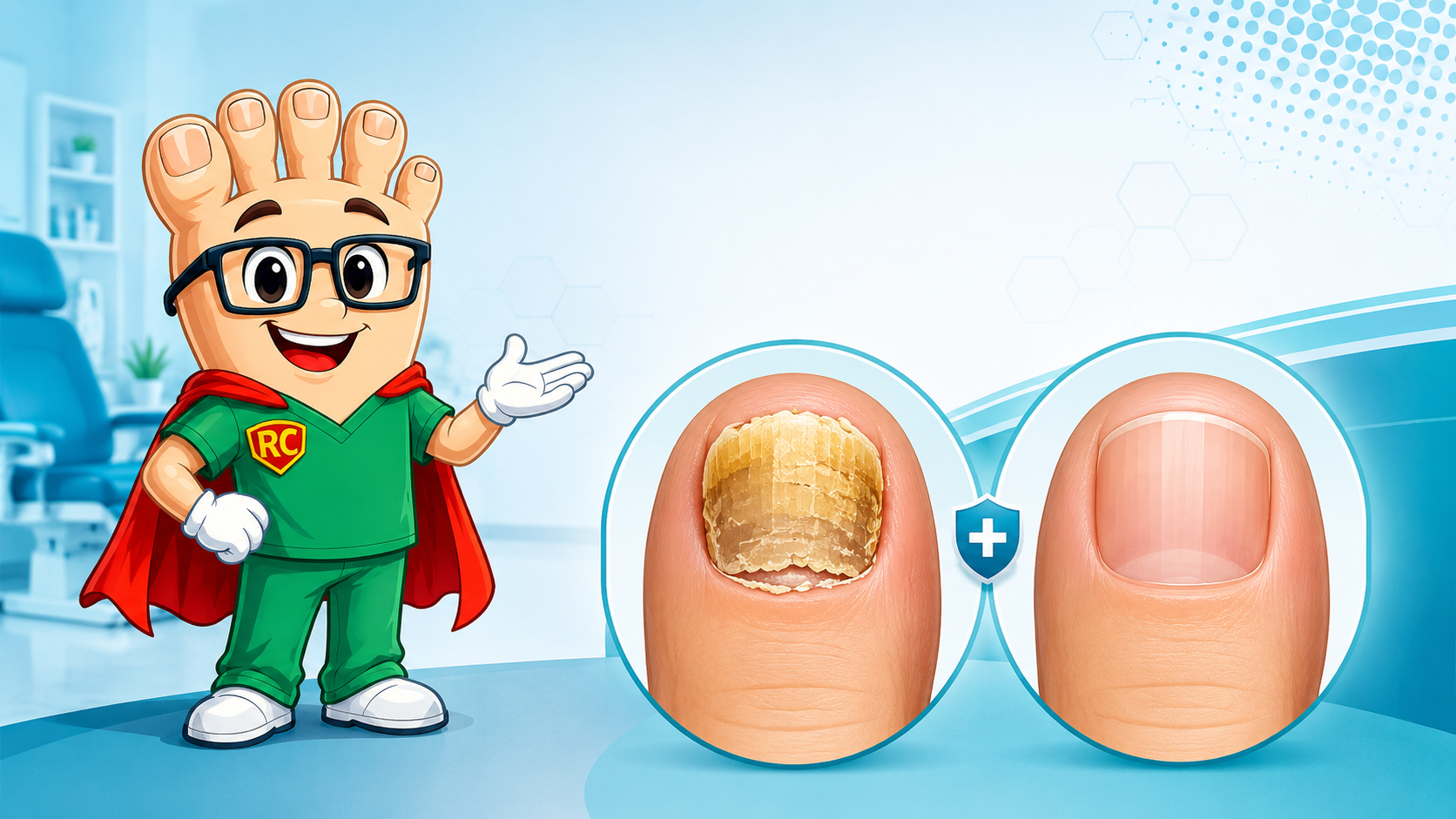
Understanding the pathology, the look-alikes, and a smarter plan for treating onychomycosis
Hi, Archie the Foot here.
Today we need to talk about one of the most frequently accused criminals in foot care:
Toenail fungus.
Yellow nail? Fungus.
Thick nail? Fungus.
Ugly nail? Definitely fungus.
Except…
Not so fast.
A damaged or discolored toenail can certainly be caused by a fungal infection, medically known as onychomycosis. But trauma, psoriasis, nail separation, other nail disorders, and even more serious conditions can sometimes produce changes that resemble fungus. Clinical studies have specifically documented that onychomycosis can mimic, and be mimicked by, psoriasis, trauma, lichen planus, and other forms of nail dystrophy.
So before we attack the nail with every bottle, pill, cream, and internet remedy we can find, let’s do something surprisingly sophisticated:
Figure out what we’re actually treating.
Archie has his detective glasses on.
First: What Is Onychomycosis?
Onychomycosis is a fungal infection involving the nail unit.
Fungi can invade the keratin-containing structures of the nail and produce changes in the nail plate, nail bed, and surrounding nail architecture. Depending on the type and severity of infection, the nail may become discolored, thickened, brittle, distorted, lifted away from the nail bed, or surrounded by debris.
In other words:
That thick yellow stuff is not simply a cosmetic problem sitting on top of the nail.
The disease can involve the structures within and beneath the nail.
And that distinction is important when we start talking about treatment.
Archie Goes Under the Nail: What Is Actually Happening?
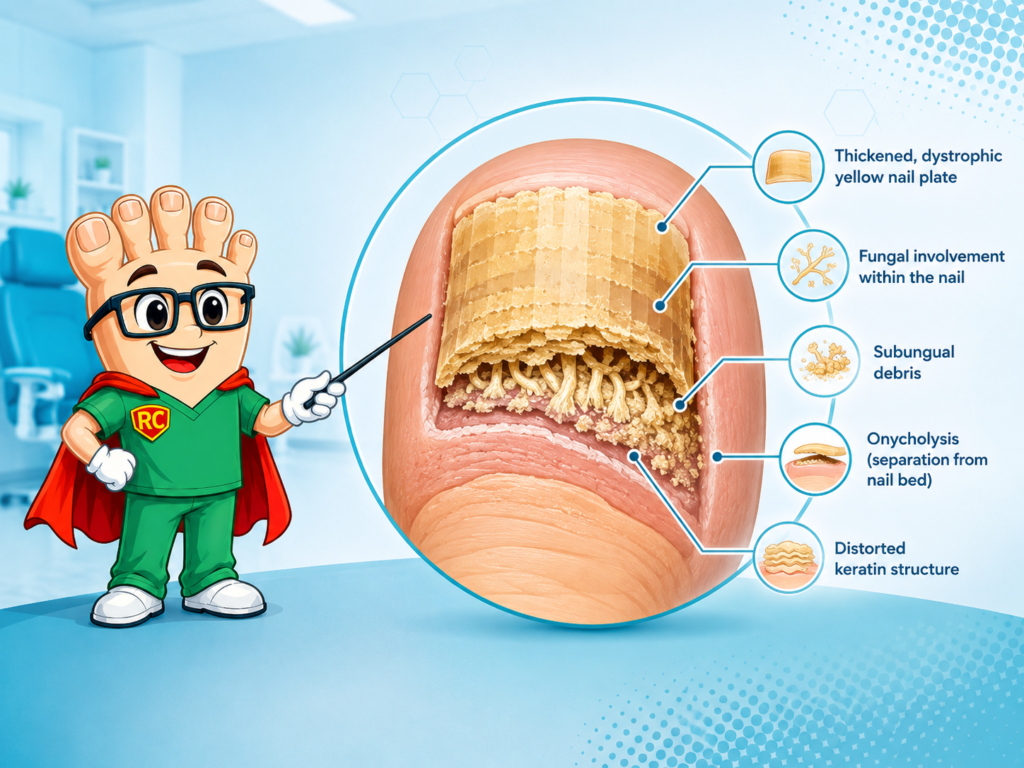
One of the most common clinical patterns is distal and lateral subungual onychomycosis.
Translation from medical school to normal English:
The infection often begins toward the end or side of the nail and progressively involves more of the nail unit.
As the process advances, several things may occur:
The nail becomes discolored. Yellow, white, tan, or brown discoloration can develop.
The nail becomes thicker. Keratin and debris can accumulate underneath the nail.
The nail becomes brittle or crumbly. Normal nail architecture becomes disrupted.
The nail can begin separating from the nail bed. This is called onycholysis.
The shape of the nail can change. Long-standing disease may eventually produce substantial nail dystrophy.
And if the disease continues long enough, what started as a small abnormal corner can eventually become a dramatically thickened and distorted nail.
That is when people usually say:
“Archie, this nail has been like this for years.”
Archie’s response:
Your toenail has been sending you mail for years. You finally opened the envelope.
But Here’s the Problem: Not Every Ugly Nail Is Fungus
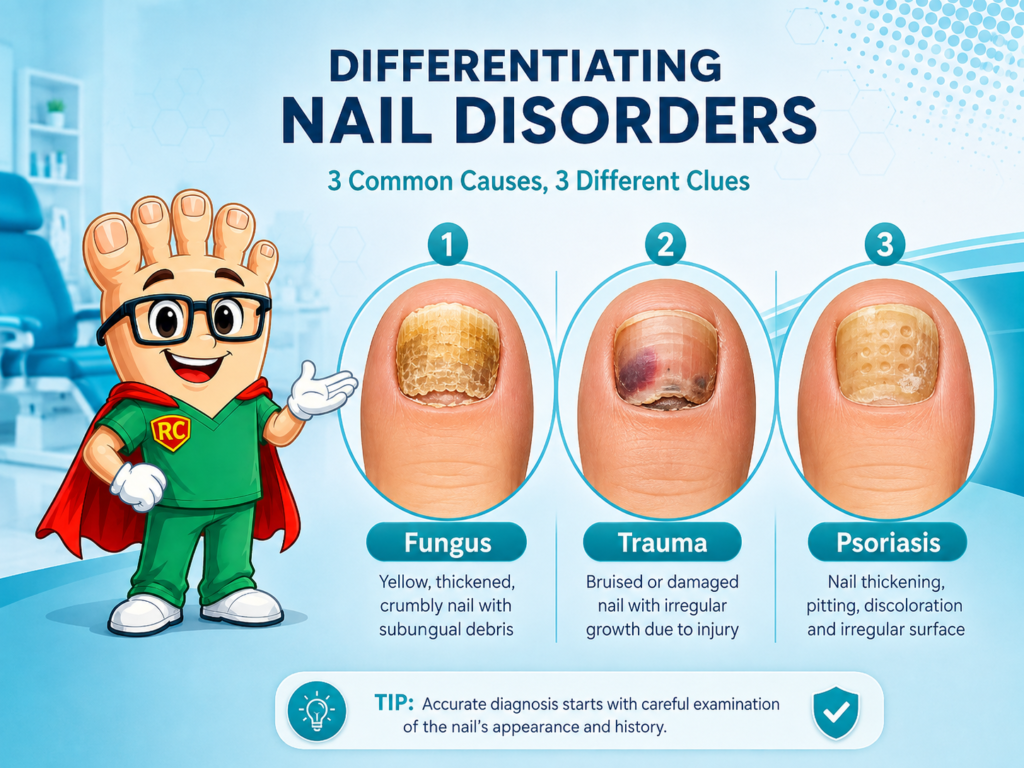
This is one of the most important lessons in fungal nail care.
Appearance alone does not always establish the diagnosis.
Several completely different conditions can create a thick, yellow, irregular, damaged, or separated nail. ToeFX itself emphasizes this diagnostic problem and identifies psoriasis, onycholysis, subungual hyperkeratosis, trachyonychia, and other conditions as potential fungal mimics.
So let’s meet a few members of Archie’s lineup.
Suspect #1: Toenail Fungus
Classic clues can include:
- Yellow, white, or brown discoloration
- Progressive thickening
- Crumbly or brittle nail
- Debris underneath the nail
- Separation of the nail from the nail bed
- Progressive involvement of additional portions of the nail
Those findings can certainly raise suspicion for onychomycosis.
But suspicion is not the same thing as proof.
Suspect #2: Repetitive Trauma
Your shoes can assault your toenails without ever receiving a criminal record.
Running, hiking, tennis, tight shoes, repetitive pressure, and repeated contact between the toe and the front of the shoe can damage a nail.
Traumatic nail dystrophy may produce:
- Thickening
- Irregular growth
- Nail separation
- Discoloration
- Bruising underneath the nail
Physical trauma is an important cause of toenail dystrophy and can closely resemble fungal disease.
So if you have spent twenty years jamming your second toe into running shoes that are half a size too small…
Archie has questions.
Suspect #3: Nail Psoriasis
Psoriasis does not always stop at the skin.
The nails can also be affected.
Psoriatic nail disease may produce pitting, thickening beneath the nail, discoloration, ridging, and other forms of nail dystrophy. In one prospective study of patients with psoriasis, nail abnormalities were common and some changes closely resembled onychomycosis.
Even more importantly:
Psoriasis and fungal infection can coexist.
That means this is not always an either-or situation.
Archie calls this the plot twist.
Suspect #4: Onycholysis
Onycholysis simply means the nail plate has separated from the nail bed.
Fungus can cause onycholysis.
But onycholysis itself does not automatically mean fungus.
Trauma and other nail disorders can also produce separation. ToeFX includes onycholysis among the conditions that may be mistaken for fungal disease.
This distinction is critical.
Treating every detached nail as fungus is like seeing smoke and automatically assuming somebody burned dinner.
Possible?
Yes.
Certain?
No.
And Then There Are Nail Changes We Shouldn’t Guess About
Some nail discolorations and structural abnormalities deserve professional evaluation before anyone assumes they are fungal.
ToeFX specifically includes melanoma among important conditions that can enter the differential diagnosis of an abnormal appearing nail.
That is why Archie’s rule is simple:
When the diagnosis is uncertain, diagnose first and treat second.
So How Do We Know if It Really Is Fungus?
The nail’s appearance provides clues.
Your medical history provides more clues.
But laboratory testing can provide another level of diagnostic confidence.
Traditional approaches can include microscopy, fungal culture, and examination of nail clippings. Clinical research demonstrates meaningful differences in sensitivity among available diagnostic methods, which is one reason no single visual finding should automatically be treated as proof of fungal infection.
Another diagnostic option is PCR testing.
PCR detects genetic material from microorganisms within the submitted nail specimen. ToeFX currently offers a PCR-based diagnostic system designed to identify fungal pathogens from nail clippings or nail dust. Its current product information states that the ToeFX PCR test is available in Canada, with U.S. availability still being developed.
Translation from Archie:
Before spending months treating fungus, it can make sense to confirm that fungus actually showed up to the party.
Once We’ve Identified Fungus, What’s the Plan?
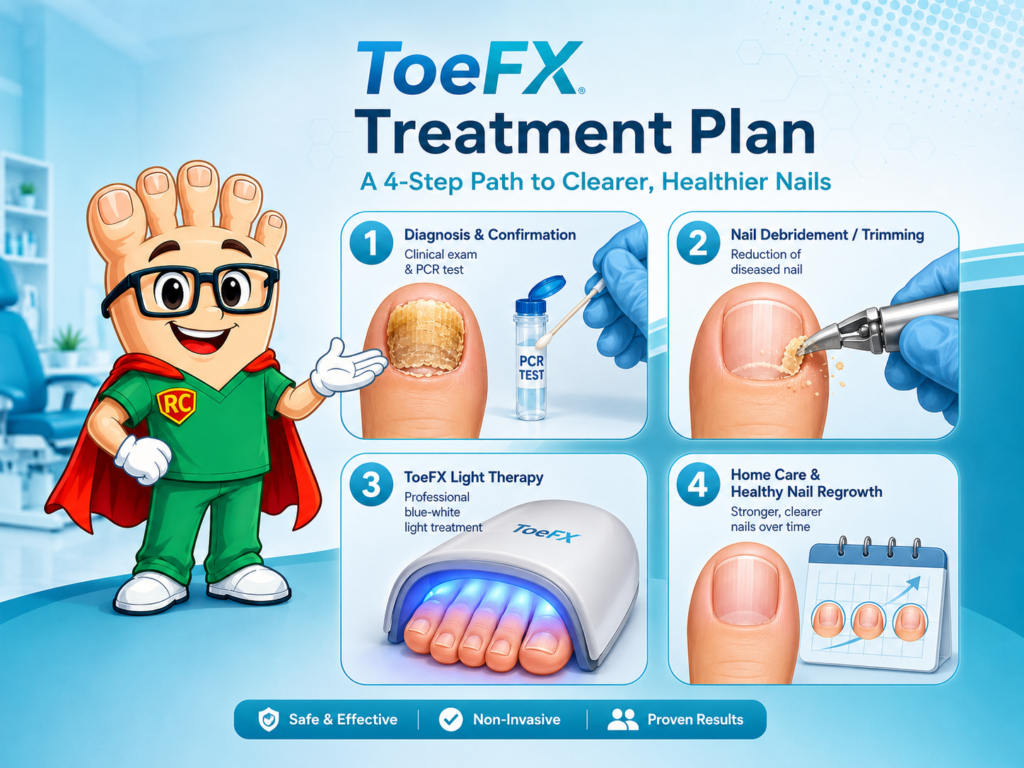
Now Archie gets to put away the detective hat and put on the treatment cape.
ToeFX uses a light-based approach to the management of onychomycosis. According to ToeFX’s current clinical protocol, treatment combines nail preparation, topical formulation, and controlled light exposure.
Here’s the basic strategy.
Step 1: Confirm the Diagnosis
Start with a proper nail examination.
Ask:
How long has the nail looked this way?
Was there an injury?
Are multiple nails involved?
Is athlete’s foot present?
Is there psoriasis?
Has the patient already tried antifungal treatment?
Is the appearance actually consistent with fungal disease?
When appropriate and available, laboratory confirmation can help establish whether fungus is present and may identify the organism involved. ToeFX’s clinical study also used KOH examination, culture, and/or PCR to confirm diagnoses among study participants.
Diagnosis first. Treatment second.
Archie is going to keep repeating that until someone puts it on a T-shirt.
Step 2: Reduce the Diseased Nail
A very thick nail creates another problem.
You are trying to treat disease protected by a substantial layer of keratin.
ToeFX’s published protocol therefore includes debridement of the affected nails before treatment, reducing nail thickness and removing part of the surface barrier before the light-based portion of the procedure.
Think of it this way:
If we’re trying to reach the problem, sometimes we first need to clear the driveway.
Step 3: Apply the ToeFX Formulation
The ToeFX treatment protocol uses a topical formulation applied to the prepared nail.
According to ToeFX, the formulation participates in the light-activated treatment process. When illuminated, localized reactive oxygen species are generated as part of the photochemical reaction.
Then comes the light.
Step 4: ToeFX Light Therapy
The affected foot is positioned under the ToeFX light source for treatment.
ToeFX describes its system as photodisinfection therapy, using light-driven photochemical reactions rather than a traditional oral antifungal drug. Its current platform is designed to deliver controlled visible light to affected nails.
Clinical research outside of ToeFX has also investigated photodynamic approaches for onychomycosis, including randomized studies demonstrating antifungal effects with light-activated therapies. However, outcomes vary by device, photosensitizer, protocol, infection severity, and study design, so different light-based systems should not be assumed to produce identical results.
That last point matters.
“Light therapy” is not one single treatment.
Wavelengths, energy delivery, photosensitizers, protocols, treatment schedules, and preparation techniques can all differ.
Step 5: Give the New Nail Time to Grow
This might be the least exciting and most important part of treatment.
The damaged nail does not instantly transform into a perfect nail after treatment.
A healthier appearing nail must grow forward.
That takes time.
So rather than staring at the same old damaged nail and asking whether it looks different tomorrow morning, clinicians typically monitor the emergence and progression of healthier new nail.
ToeFX’s current clinical study reporting describes treatment response partly in terms of total clearance or measurable healthy new nail growth.
Archie’s recommendation:
Take pictures.
Toenails grow slowly enough that your memory is terrible at detecting gradual improvement.
Your camera is better.
Step 6: Don’t Forget the Environment
Treating the nail without thinking about why fungal organisms keep returning can create a frustrating cycle.
Foot hygiene, moisture control, footwear, concomitant athlete’s foot, nail care, and reducing repeated exposure may all become part of a comprehensive fungal nail strategy.
And if the nail is repeatedly traumatized by footwear, fixing the fungus without fixing the shoe problem leaves another source of nail injury untouched.
Because sometimes the fungus isn’t working alone.
It has accomplices.
Archie’s Three Rules for Toenail Fungus
If you remember nothing else from this article, remember these:
Rule #1: Don’t diagnose fungus entirely by color.
A yellow nail is a clue.
It is not a laboratory report.
Rule #2: Treat the disease, not just the appearance.
Onychomycosis involves the nail unit, and severe disease can create substantial structural changes.
Rule #3: Healthy nail growth is the finish line.
Killing or suppressing microorganisms is only part of the objective.
The outcome patients actually want is a healthier, clearer nail growing forward.
And that requires the right diagnosis, the right treatment plan, and something modern medicine has still been unable to eliminate:
Patience.
Archie’s Bottom Line
Toenail fungus can be stubborn.
But the bigger mistake is spending months treating a nail that was never fungal in the first place.
A thoughtful approach looks something like this:
LOOK → DIFFERENTIATE → TEST WHEN APPROPRIATE → PREPARE → TREAT → MONITOR REGROWTH
That is a much smarter strategy than:
Yellow nail → buy random bottle → hope.
ToeFX combines diagnostic tools, nail preparation, and light-based treatment into a structured approach to onychomycosis management.
Think You Have Toenail Fungus?
Start by finding out what is actually happening underneath the nail.
Find a ToeFX Partner Clinic near you to discuss your nail changes and whether ToeFX may be appropriate for your condition. ToeFX maintains a current directory of partner clinics for patients seeking treatment.
Because when it comes to toenails, Archie believes in one thing above all else:
Don’t guess. Diagnose. Then treat.